

Every spring, homeowners across Metro Detroit walk out onto a deck that made it through another winter looking worse than it did the year before. The boards cupped. The stain faded to gray. Something underfoot feels spongy.
The best decking material for most Michigan homes is capped composite. It handles freeze-thaw cycles, resists the road salt that gets tracked onto it all winter, and needs nothing more than soap and water once a year. Pressure-treated lumber still wins on upfront cost, and cedar still wins on looks. The right answer depends on which trade-off you can live with for the next 25 years.
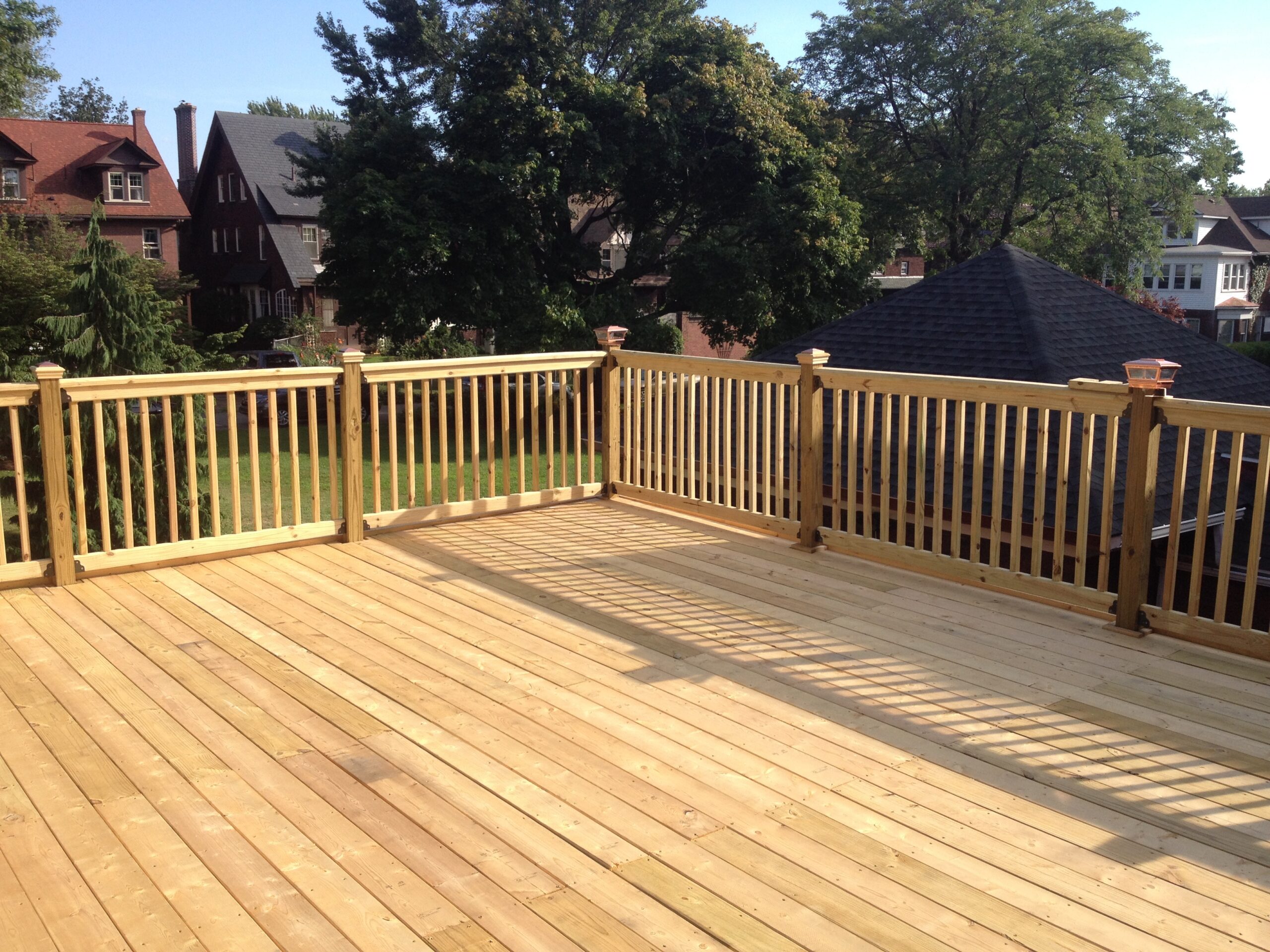
Which Deck Material Is Right for Your Situation?
Before the detail, here’s the short version. Find the line that sounds like you.
- You want the lowest upfront number. Pressure-treated lumber. Budget $5,000 to $15,000 for a typical backyard deck, and plan on sealing it every two to three years.
- You want real wood and you don’t mind the upkeep. Western red cedar. Expect 15 to 25 years, and expect to clean and seal it annually.
- You want to stop thinking about it. Capped composite. Higher upfront, lower over its life, and it holds up to Michigan winters better than anything wood can do.
- Your deck sits near water or takes constant moisture. PVC. It absorbs nothing at all, which matters more than it sounds on a Lake St. Clair property.
- Your deck bakes in full afternoon sun and you go barefoot. Light-colored composite or PVC, or cedar. Dark synthetic boards get genuinely hot.
Which Deck Material Factors Matter Most in Michigan?
National decking guides rank materials on durability, cost, and looks. That’s fine, but it ignores the four conditions that actually destroy decks here.
How Do Freeze-Thaw Cycles Damage a Deck?
Southeast Michigan crosses the freezing line dozens of times between November and March. Water gets into a board, freezes, expands, and pushes the wood fibers apart. Then it thaws and does it again. On pressure-treated lumber, this is what causes the checking, splitting, and cupping you see on decks around year eight. Composite and PVC boards don’t absorb water the same way, so the cycle has far less to work with.
Does Road Salt Really Reach Your Deck?
It does, and most homeowners underestimate it. Salt comes off boots, off pets, and off any de-icer applied to the deck itself. Chloride accelerates corrosion on fasteners and connectors, and it breaks down the surface of unsealed wood. If you plan to de-ice your deck at all, that alone is an argument for a capped synthetic board and stainless or coated structural hardware.
What Does Lake-Effect Moisture Do to Decking?
Homes in St. Clair Shores, Grosse Pointe, and the eastern Macomb County communities near the water deal with higher sustained humidity than inland properties. Sustained moisture feeds mold growth on the shaded underside of boards and in the gaps between them. Natural wood needs diligent sealing to survive it. PVC is effectively immune.
How Much Does Heavy Foot Traffic Matter?
A deck that hosts a grill, a dining table, and regular gatherings takes more surface abuse than one nobody walks on. Softer woods dent. Uncapped composite scratches. Capped composite and dense tropical hardwoods hold up best under furniture that slides and dogs that sprint.
What Are Your Deck Material Options?
These are the materials worth considering for a Michigan deck, along with what each one actually costs and how long it lasts here.
Pressure-Treated Lumber
Still the most commonly used decking material in the country, and still the cheapest way to get a deck built. Preservatives are driven into the wood fibers under pressure, which gives it real resistance to rot, decay, and insects. Since 2003, residential pressure-treated wood uses alkaline copper quaternary or copper azole rather than the arsenic-based treatments of the past. Those newer formulations are safer, and also somewhat less aggressive at long-term preservation, so maintenance matters more than it used to.
Board material runs roughly $3 to $6 per square foot at 2026 pricing. Expect 15 to 25 years in Michigan with consistent upkeep, which means cleaning annually and sealing or staining every two to three years. Skip that and you’ll see splitting well before year 15.
Cedar Lumber
Western red cedar contains natural oils and tannins that repel insects and resist rot without any chemical treatment. It’s dimensionally stable, so it warps and cups less than pressure-treated pine does through temperature swings. It’s also lighter and easier to work with, and it ages to a silver-gray patina if you let it.
Board material lands around $6 to $12 per square foot, roughly double pressure-treated. Lifespan is 15 to 25 years with annual cleaning and sealing. If you love the look and grain of real wood, cedar is the honest choice. Just go in knowing you’re signing up for a Saturday of work every spring.
Composite Decking
Composite boards blend wood fibers with recycled plastic, then wrap that core in a protective polymer shell. The shell is the part that matters. Uncapped composite, which is what the earliest generations were, will still fade and stain. Capped composite resists UV fading, food and beverage stains, scratching, moisture absorption, and mold.
Board material spans a wide range depending on the line, from roughly $5 per square foot on value products up to $18 on premium collections. Installed project totals typically land between $12,000 and $30,000 for a backyard deck. Lifespan is 25 to 30 years, with manufacturer warranties commonly running 25 years and reaching 50 on some premium lines. Maintenance is a wash with soap and water, or a pressure washer kept below 2,500 psi.
What Is the Difference Between Three-Sided and Four-Sided Capping?
Trex caps the top and both sides of each board, leaving the bottom open so any moisture that does get in can escape rather than getting trapped. TimberTech fully encapsulates the board on all four sides, sealing moisture out entirely. Both approaches work. The four-sided approach has a slight edge in continuously damp locations, which is why it comes up often on waterfront properties. Whatever you choose, avoid uncapped boards in this climate.
Is Trex or TimberTech Better?
This is the most common question homeowners bring to a deck consultation, and the honest answer is that they win on different things.
Trex holds the edge on scratch resistance, which matters if you have dogs, kids, or furniture that gets dragged rather than lifted. It also generally prices below TimberTech line for line, and it leads on recycled content at roughly 95 percent reclaimed wood fiber and plastic film.
TimberTech holds the edge on moisture resistance, largely because of the four-sided cap, and its Advanced PVC line goes further still. It offers more convincing wood grain and a wider color range, and it extends fade and stain coverage beyond what Trex offers on comparable lines.
For a typical Metro Detroit backyard, Trex is the better value. For a shaded yard, a pool surround, or anything near the water, TimberTech is worth the difference. We install both, and the recommendation changes with the site rather than the brand.
PVC Decking
PVC contains no wood at all. No organic material means nothing for mold to feed on and nothing to absorb water, which makes it the most moisture-resistant decking you can buy. It’s also the lightest option, and some lines carry a Class A fire rating.
Board material is the highest of any option at roughly $9 to $14 per square foot, and premium cellular PVC climbs from there. Lifespan runs 30 to 50 years. The trade-off is aesthetic. PVC has gotten far more convincing in recent years, but a discerning eye can usually still tell it apart from real wood up close.
Aluminum and Exotic Hardwoods
Aluminum decking is genuinely bulletproof against rot, mold, insects, and fire, and it handles temperature swings without complaint. It’s uncommon on residential projects in Metro Detroit, mostly because the look reads commercial to a lot of homeowners. Tropical hardwoods like ipe and Brazilian walnut are extraordinarily dense and durable, with a rich color that nothing synthetic quite matches, but they carry a premium price and still require oiling to hold that color.

Which Deck Material Handles Freeze-Thaw and Heavy Foot Traffic Best?
On freeze-thaw, PVC is first, capped composite is a close second, cedar is third, and pressure-treated lumber is last. The ranking follows water absorption almost exactly.
On foot traffic, the order changes. Dense tropical hardwoods resist denting better than anything. Capped composite comes next and is the practical winner for most families, since it resists scratching from furniture and pet claws without the cost or upkeep of ipe. Cedar is a soft wood and will show dents from dropped grill tools and dragged chairs. Pressure-treated pine falls in the middle on hardness but loses ground as it weathers.
If your deck is both exposed and busy, capped composite is the material that does not force you to pick one problem to solve.
How Do Long-Term Costs Compare Between Decking Materials?
Upfront price tells you almost nothing useful. Cost per year of service is the number that matters.
For national context, Zonda’s 2025 Cost vs. Value Report put the average wood deck addition at $18,263 and the average composite deck addition at $25,096. That roughly $7,000 spread is the number most homeowners are deciding on. Here’s what it buys you.
A pressure-treated deck that costs $9,000 to build and needs roughly $600 to $800 in cleaning and sealing supplies and labor every three years, over a 20-year life, lands somewhere near $600 per year all in. A composite deck at $20,000 with almost no recurring cost, over a 28-year life, lands near $720 per year. Those are closer than most homeowners expect, and the composite deck looks better in year 15.
Cedar sits between the two, with a lower entry point than composite and a higher annual maintenance burden. PVC has the highest entry cost and the lowest lifetime cost, but you have to stay in the house long enough to collect on that.
For a full picture of what a deck project costs locally, including permit fees and site-specific variables, see our guide to deck costs and permits in St. Clair Shores.
Which Deck Material Works Best for Waterfront and Salt-Exposed Homes?
PVC, and it isn’t close. On a property near Lake St. Clair or along a canal, boards face sustained humidity, splash exposure, and in many cases direct contact with damp air underneath the structure where nothing dries out.
Solid-core PVC absorbs no water, so there is no freeze-thaw damage and no mold substrate. Four-sided capped composite is a reasonable second choice. Untreated or lightly sealed natural wood is a mistake in these locations, and so is pressure-treated lumber left without a maintenance schedule.
Structural hardware deserves the same attention. Salt and moisture corrode fasteners long before they compromise the boards, so stainless steel or heavily coated connectors are worth the upgrade on any waterfront build.
Which Decking Material Needs the Least Maintenance in Michigan?
Ranked by hours you’ll spend per year:
- PVC. One wash per year. Nothing else.
- Capped composite. One or two washes per year with soap and water. No sealing, no staining, no painting.
- Cedar. Annual cleaning plus sealing to hold color, or let it weather gray and clean it once a year.
- Pressure-treated lumber. Annual cleaning, plus sealing or staining every two to three years, plus occasional board replacement.
A note on cleaning products. Harsh de-icers and chlorine-based cleaners break down synthetic board surfaces over time, and metal brushes leave permanent marks on composite. Calcium chloride is gentler on decking than rock salt. For a season-by-season schedule, our year-round deck maintenance guide covers what to do and when.
How Should a Deck Be Built for Michigan Freeze-Thaw Conditions?
Material choice is half the outcome. Installation is the other half, and it’s where most premature deck failures actually start.
Joist spacing has to match the board. Many composite products require 16 inches on center for standard installation and 12 inches for diagonal patterns, and going wider produces a bouncy deck that voids the warranty. Thermal gapping matters too, since synthetic boards expand and contract along their length more than wood does, and butt joints installed tight in January will buckle in July.
Airflow underneath is non-negotiable in this climate. A deck built too close to grade, or skirted solid with no ventilation, traps moisture against the framing and rots it from below while the surface still looks fine. Proper ledger flashing is equally critical, because a badly flashed ledger board channels water directly into your rim joist and siding.
Hidden fastener systems give you a cleaner surface with no exposed screw heads, and they eliminate the water intrusion points that face-screwing creates.
Which Permits and Codes Apply Before You Build?
Michigan still operates under the 2015 Residential Code. A July 2025 court order paused the state’s adoption of the 2021 International Residential Code, so any contractor or online guide citing the 2021 code as current for Michigan residential work is wrong. You can confirm the current status on the LARA Bureau of Construction Codes rules page.
Permits are handled at the municipal level and requirements vary. In St. Clair Shores, permit fees are based on job valuation, and projects over $7,000 require a refundable $500 bond. Neighboring communities set their own fee schedules and inspection requirements, so verify with your city before work begins.

What Problems Should Michigan Homeowners Expect, and How Are They Fixed?
Most deck complaints trace back to a handful of causes.
- Warped or cupped boards. Usually poor ventilation underneath, sometimes boards installed bark-side down. Improve airflow first, then replace the affected boards.
- Squeaking or movement. Fasteners backing out through seasonal expansion. Re-fasten with the correct screw type for the material rather than driving the old ones deeper.
- Staining on composite. Most food and grease marks lift with warm water and a soft-bristle brush. Skip the metal brush, which leaves marks worse than the stain.
- Mold on shaded sections. Clean it, then address the cause. Trim back vegetation crowding the deck and raise planters onto risers so water doesn’t pool.
- Soft or spongy spots. This is structural, not cosmetic. Stop using that section and get it inspected.
Why Choose Leach Construction for Your Deck?
We’ve been building in Metro Detroit since 1965, when the company operated as Rich & Sons Home Improvement, and we’ve carried that work forward under the Leach name since 2017.
- ✓ Licensed and accountable. Michigan Residential Builder License #262000527, with owners Dennis Leach and Michael Perri involved on projects directly.
- ✓ Materials we actually install. Trex composite, TimberTech composite and PVC, treated lumber, and cedar. We’ll tell you when the less expensive option is the right one for your situation.
- ✓ Complete railing options. Aluminum, steel cable, PVC, and wood, matched to the decking you choose.
- ✓ 7-year workmanship warranty on top of whatever the manufacturer covers.
- ✓ Financing available. 0% for 25 months on approved credit.
- ✓ Local code knowledge. We pull permits and pass inspections across Wayne, Oakland, Macomb, St. Clair, and Washtenaw counties.
You can see completed projects in our portfolio, or read more about our deck building services.
Frequently Asked Questions
What is the best deck material for Michigan weather?
Capped composite for most homes, and PVC for properties with constant moisture exposure. Both resist the freeze-thaw damage and road salt that shorten the life of wood decks in Southeast Michigan.
How much does a 20×20 deck cost in Metro Detroit?
A 400 square foot pressure-treated deck typically runs $8,000 to $15,000 installed. The same footprint in composite generally lands between $16,000 and $30,000, depending on board line, railing selection, and site conditions like grade and access.
What type of wood is best for a deck in Michigan?
Western red cedar. Its natural oils resist rot and insects without chemical treatment, and it stays dimensionally stable through temperature swings better than pressure-treated pine does.
Does composite decking get too hot for bare feet?
Dark composite and PVC boards in full afternoon sun can get uncomfortably hot, more so than natural wood. Lighter colors reduce the problem substantially. If your deck faces west with no shade, this is worth factoring into the color decision.
What are the negatives of composite decking?
Higher upfront cost, heat retention in dark colors, and more thermal movement than wood, which makes correct gapping during installation important. Uncapped composite also fades and stains, so the capped lines are worth the difference.
How long does a deck last in Michigan?
Pressure-treated lumber runs 15 to 25 years with consistent maintenance. Cedar runs 15 to 25. Capped composite runs 25 to 30. PVC runs 30 to 50. In every case, ventilation and drainage under the deck affect the outcome as much as the board itself.
Should I build a deck myself or hire a contractor?
Surface board replacement is within reach for a confident DIYer. New structural work is not, because ledger attachment, footing depth, and load calculations are where mistakes become dangerous rather than just ugly. Michigan requires a licensed residential builder for most structural deck work, and your municipality will require inspection regardless of who builds it.
Does homeowners insurance cover storm damage to a deck?
Often yes, if the deck is attached to the home and the damage came from a covered peril like wind or a fallen tree. Damage from gradual rot or deferred maintenance is generally excluded. Document the damage with photos before any cleanup.
Ready to Talk Through Your Deck?
The right material depends on your budget, your site, and how much upkeep you’re willing to take on. We’ll walk your property, tell you what the conditions actually call for, and give you a written estimate with real numbers.
Call Leach Construction at 586-822-1981 or request a quote online.
About the author
Dennis Leach is co-owner of Leach Construction LLC in St. Clair Shores, Michigan, alongside Michael Perri. The company has been building for Metro Detroit homeowners since 1965, when it operated as Rich & Sons Home Improvement, and took the Leach Construction name in 2017. Leach Construction holds Michigan Residential Builder License #262000527 and serves Wayne, Oakland, Macomb, St. Clair, and Washtenaw counties. More about the company.