
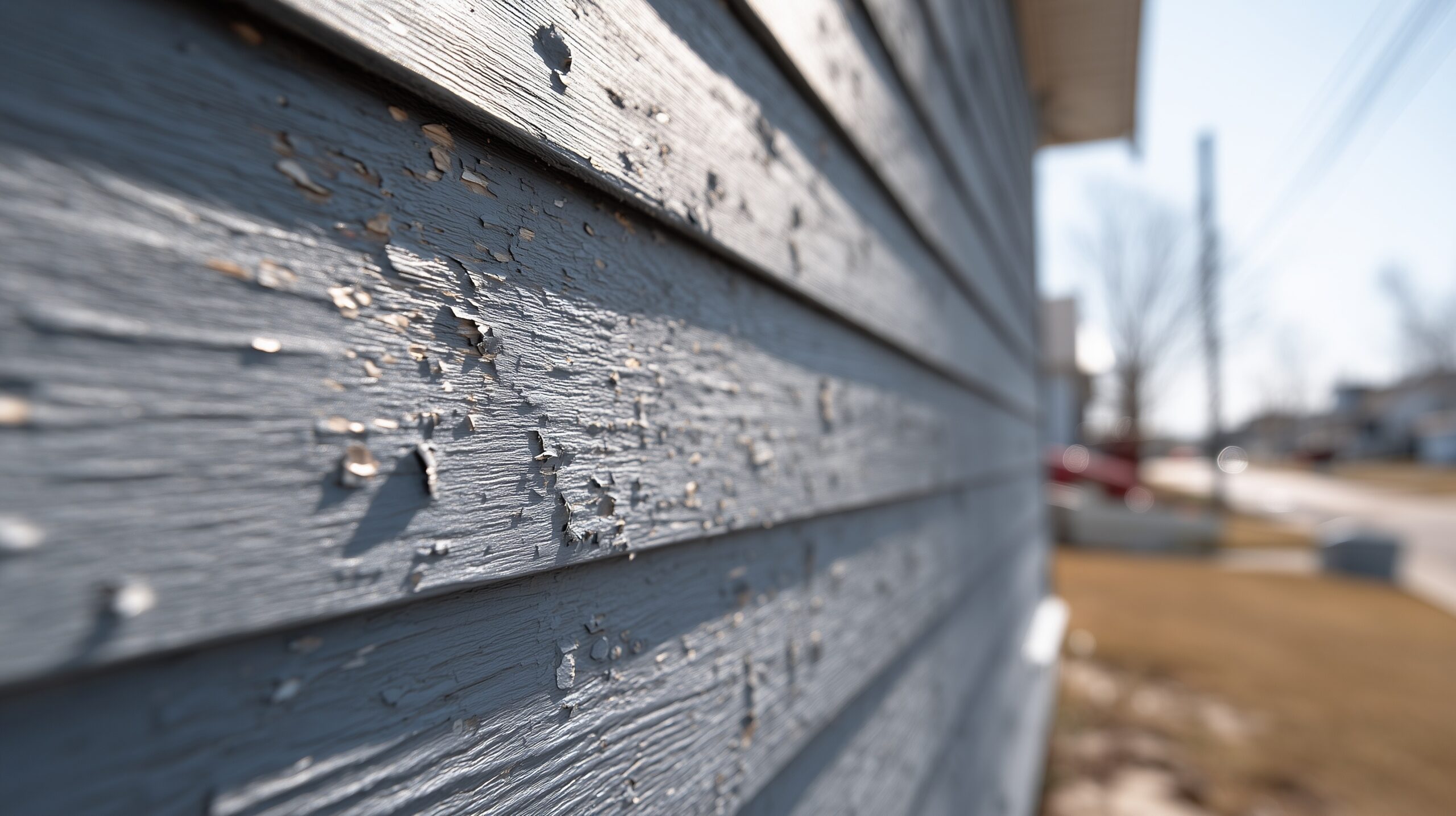
Walk around your house after a Michigan winter and you’re bound to spot something – a cracked panel, a section that’s pulling away, faded color on the south side. The question hits every homeowner eventually: do you patch it, or is it time for a full replacement?
It’s a real decision, and one that homeowners deserve an honest answer to. Some siding damage truly is a $400 repair. Some genuinely warrants a $30,000 replacement. The challenge is knowing which situation you’re actually looking at before you spend money in the wrong direction.
Repair your siding when damage is localized to one wall or a small section, your siding is under 15 years old, and the underlying sheathing is sound. Replace it when damage spans multiple walls, your siding is past about 75% of its expected lifespan, repairs would void your manufacturer warranty, or you’ve had repeated repair calls in recent years.
This guide gives you the framework Leach Construction uses when we walk a property with a homeowner. We’ve been making this call alongside Metro Detroit families since 1965, and we’ll show you how to evaluate your own situation – when repair makes sense, when replacement is the smarter call, the middle-ground option most homeowners don’t know exists, and how Michigan’s climate and recent storm activity change the math.
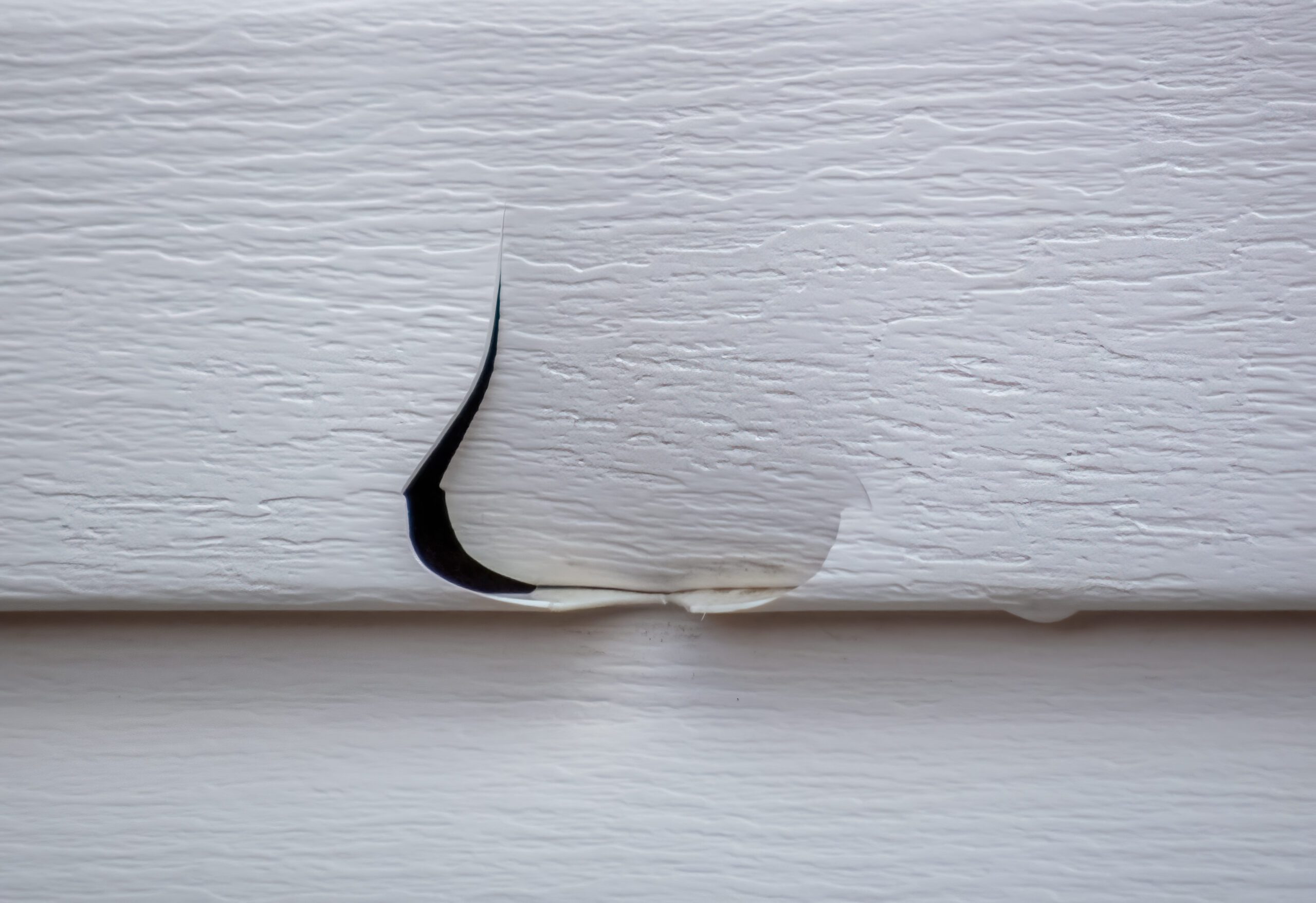
A small, tear-shaped hole has appeared in a white vinyl siding panel, indicating potential hail damage or structural issues.
When Does Siding Repair Actually Make Sense?
Repair gets a bad reputation, and honestly, that’s partly the industry’s fault – contractors make more money on replacement. But for the right kind of damage, repair is genuinely the right answer. It’s faster, dramatically cheaper, and protects your home just as well when done properly.
What Kinds of Damage Are Genuinely Repairable?
The clearest candidates for repair share three traits: the damage is localized, the cause is identifiable, and the surrounding siding is in good shape.
Specific examples that typically repair well:
- ✓ A few cracked or impact-damaged panels from a storm, fallen branch, or stray baseball
- ✓ One section of loose siding where fasteners pulled out but the panels themselves are intact
- ✓ Isolated holes from old satellite dish mounts, removed light fixtures, or pest entry points
- ✓ A single panel warped from a heat source like an outdoor grill placed too close to the wall
- ✓ Localized hail damage to one or two elevations rather than the whole home
In these cases, a skilled contractor can swap out the affected panels, address whatever caused the problem, and you’re back to a fully protected home for a fraction of replacement cost.
How Old Is Too Old for Siding Repair?
Age changes the math significantly. Even if today’s damage is localized, repairing 20-year-old vinyl siding rarely makes sense because the next problem is probably coming soon.
General guidelines by material:
- Vinyl siding: Repairs are reasonable up to about 15 years old. After that, brittleness, fading, and material discontinuation start working against you.
- Fiber cement (James Hardie): Often repairable well into the 20-25 year range thanks to longer material lifespan, though color matching becomes harder as ColorPlus finishes weather.
- Aluminum siding: Frequently 30+ years old at this point, with discontinued profiles and colors making matching nearly impossible.
- Wood siding: Highly variable – depends entirely on maintenance history rather than calendar age.
If your siding is approaching the end of its expected lifespan, money spent on repair is often money you’ll spend again on replacement within a few years.
When Is the Underlying Structure Still Solid?
Your siding is only the outer layer of a system. Behind it sits the moisture barrier (house wrap) and the sheathing – typically OSB or plywood attached to your home’s framing. When you repair siding, you need to verify everything behind it is still doing its job.
A reputable contractor will pull the damaged section, inspect the sheathing and house wrap, and address any problems they find before installing replacement panels. If the sheathing is dry, structurally sound, and the moisture barrier is intact, a localized repair will hold up just fine.
If the sheathing shows soft spots, water staining, or rot, the conversation shifts. That hidden damage is usually a sign of long-term water intrusion that may extend beyond what’s visible, which often pushes the decision toward broader replacement.
When Should You Replace Your Siding Instead?
Replacement makes sense when the problems you’re seeing aren’t isolated incidents – they’re symptoms of a system that’s reached the end of its useful life.
How Do You Know When Damage Is Too Widespread to Repair?
The single biggest factor in the repair-or-replace decision is how widespread the damage is. Damage limited to one wall or one corner tells a very different story than problems showing up on three or four elevations.
Walk your property and count. If you see warping, cracking, or loose panels on a single wall, that’s likely repairable. If those same problems are scattered across multiple sides of your home, the underlying issue is age, weather exposure, or installation problems affecting the entire siding system – not just a few panels that need help.
As a general rule, when damage affects more than about 25-30% of your siding’s total surface area, repair stops making economic sense compared to full replacement.
What About Hidden Moisture Damage?
Water rarely causes damage in just one place. When moisture finds a way behind your siding, it spreads. Gravity pulls it down, wind drives it sideways, and capillary action moves it through wood fibers.
The “find one, find many” rule applies here: visible signs of moisture damage usually indicate broader problems behind the siding that aren’t yet visible from outside. Soft sheathing in one spot often means soft sheathing in several spots.
Warning signs of moisture problems behind your siding:
- Soft spots when you press against the wall
- Interior signs like peeling paint, stained drywall, or musty smells along exterior walls
- Visible mold or mildew that returns shortly after cleaning
- Bubbling, blistering, or paint failure on the siding surface
- Sagging or wavy siding lines
If you’re seeing these signs across multiple areas, replacement is usually the more responsible long-term choice. You’re not just replacing siding at that point – you’re rebuilding a failing weather barrier. For more on the seasonal warning signs to watch for, see our guide on whether your siding is ready for winter.
When Do Repair Costs Start Approaching Replacement Costs?
Here’s the math nobody talks about. A single panel repair might cost $200-$500. Repairing one wall might cost $2,000-$4,000. Each individual repair feels reasonable in isolation.
But if you’ve done three separate repairs in the last five years totaling $8,000, and your home would have cost $25,000-$35,000 to fully re-side, you’re a third of the way to a full replacement and you still have aging siding that will need more attention soon. According to the 2025 Cost vs. Value Report, vinyl siding replacement returns roughly 171% of its cost at resale in the East North Central region that includes Michigan, while fiber cement returns approximately 153% – so when replacement is the right call, it’s also one of the higher-ROI exterior projects you can take on.
Track what you’ve actually spent on siding repairs over the last 3-5 years. When repair spending hits about 25-30% of what full replacement would cost, the decision usually tips toward replacement – especially if your siding is approaching the end of its expected lifespan.
When Is Your Siding’s Material at End-of-Life?
Every siding material eventually reaches a point where repairs are just delaying the inevitable. Common end-of-life signals by material:
- Vinyl: Panels become brittle and crack when handled, color is heavily faded or chalky, original color is discontinued by manufacturer
- Fiber cement: Cracks in multiple boards (often from impacts or freeze-thaw), severe surface erosion, paint or ColorPlus finish failure across most panels
- Aluminum: Widespread dents that can’t be popped out, oxidation creating a chalky surface, fastener corrosion causing panels to loosen
- Wood: Multiple boards with rot or insect damage, persistent paint failure despite proper prep, splitting at fastener points
When you’re seeing these signs across most of your home, you’ve passed the point where repair makes financial sense.
A Simple Decision Framework for Repair vs. Replace
If you want a clearer way to evaluate your specific situation, work through these five questions. Your answers will point you toward repair, partial replacement, or full replacement.
Question 1: How Widespread Is the Damage?
- One panel, one corner, or one isolated area → likely repair
- One full wall or elevation → consider partial replacement
- Multiple walls or scattered across most of the home → likely full replacement
Question 2: How Old Is Your Current Siding?
- Under 10 years (vinyl) or under 15 years (fiber cement) → repair if other factors align
- Approaching expected lifespan but not past it → evaluate repair cost vs. remaining useful life
- Past expected lifespan → replacement is usually the better long-term value
Question 3: Are You Fixing the Same Problems Repeatedly?
- First repair, isolated cause → repair
- Second or third repair in a few years → investigate why before deciding
- Recurring problems despite multiple repair attempts → likely replacement
Question 4: Is the Damage Cosmetic or Structural?
- Surface-level: dents, isolated cracks, color fading → often repair
- Compromising the weather barrier: gaps, missing panels, moisture intrusion → urgent repair or replacement
- Underlying sheathing damage: rot, soft spots, mold → replacement is usually safer
Question 5: What’s the Repair Cost as a Percentage of Replacement Cost?
- Under 15% of replacement → repair clearly wins
- 15-25% → repair still typically wins if siding is in good shape otherwise
- 25-40% → tough call, depends heavily on age and remaining lifespan
- Over 40% → replacement is almost always the better long-term value
If most of your answers fall in the “repair” range, get a localized repair done quickly before the damage spreads. If most fall in the “replacement” range, start gathering estimates for full replacement before another season of weather extends the problems.
Why Michigan Weather Changes the Repair vs. Replace Math
The repair-or-replace decision plays out differently in Michigan than it does in mild-climate regions. Our weather accelerates problems that would develop slowly elsewhere, and that affects how long a repair will actually hold up.
How Do Freeze-Thaw Cycles Affect Repair Longevity?
Michigan typically sees 50 or more freeze-thaw cycles per year, sometimes happening within a single 24-hour period when temperatures swing from below freezing to above and back again. Each cycle expands and contracts every material on your home’s exterior.
For repaired siding, this matters because any imperfect seal, any slight gap, any spot where the new panel doesn’t quite match the old one becomes a potential entry point for moisture. Water gets in, freezes, expands, and makes the gap bigger. The next thaw lets more water in. A repair that would hold up for 10-15 years in a milder climate may need attention within 3-5 years here if it wasn’t done right.
The takeaway isn’t that repairs don’t work in Michigan – quality repairs absolutely do. It’s that installation quality matters even more here than in milder climates, and any compromise in the repair becomes a problem faster. This is exactly why we recommend working with a licensed Michigan Residential Builder who installs to manufacturer specifications and understands what our freeze-thaw cycles do to a wall system.
When Storm Damage Tips the Math Toward Replacement
The March 2026 windstorms across Southeast Michigan exposed a common pattern: distributed damage. When 71 mph gusts work over a home for hours, the damage isn’t concentrated in one place – it’s scattered across multiple elevations. A panel ripped off here, another cracked there, fasteners loosened on a third wall.
This kind of scattered storm damage often tips the decision toward replacement, especially when insurance is involved. Repairing five panels across four walls costs nearly as much as a section replacement once you factor in mobilization, scaffolding, and contractor time. If insurance is covering significant storm damage anyway, full replacement frequently makes more sense than a piecemeal repair approach. For more on the post-storm assessment process, see our Michigan storm damage guide.
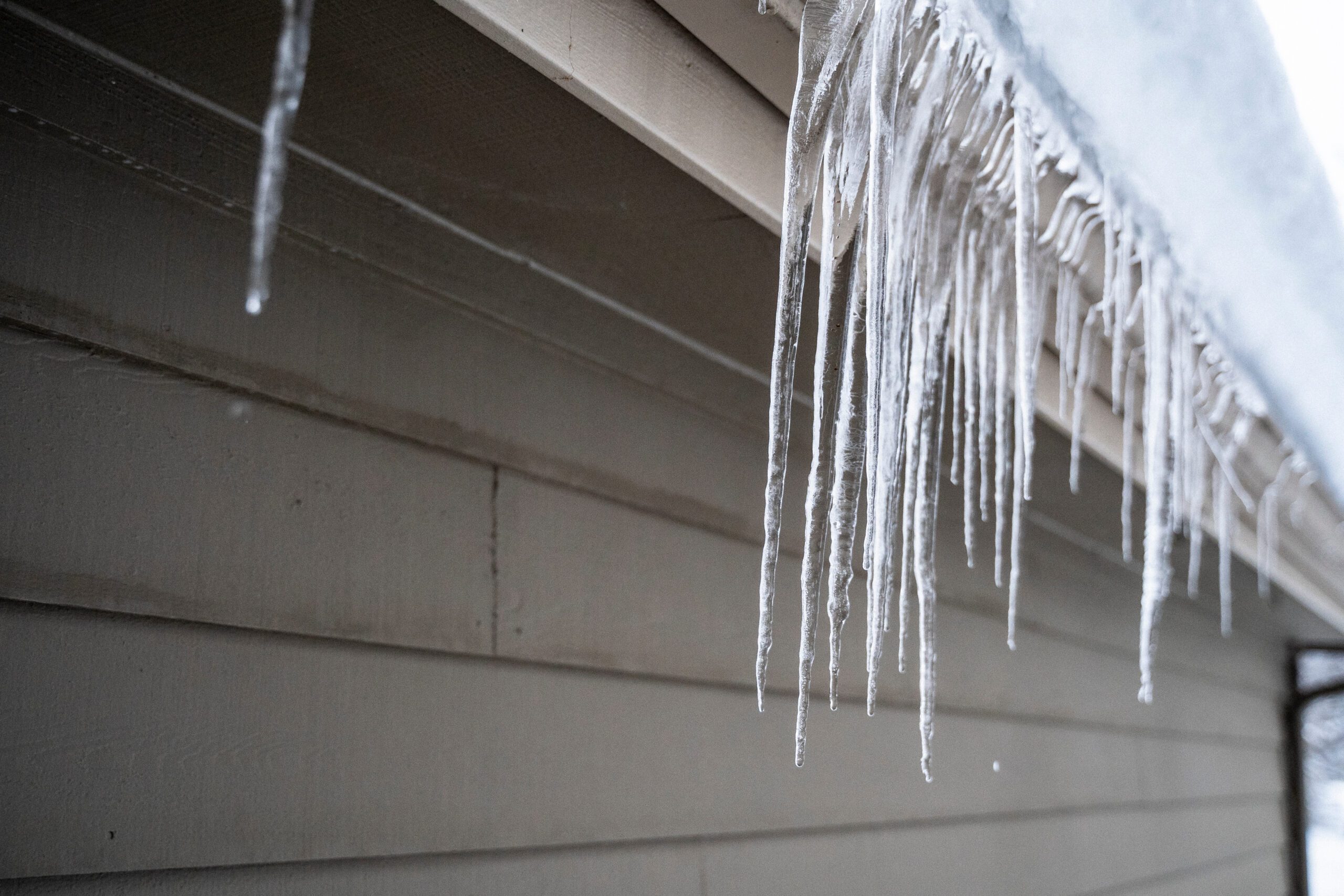
Why Ice Dam Zones Often Need Replacement, Not Repair
If you have a history of ice dams at your roofline, the siding directly below the eaves takes repeated water intrusion every winter. Even when the visible damage looks minor, the moisture barrier behind those panels may be compromised from years of water working its way down behind the siding.
In these zones, surface repair often doesn’t address the actual problem. The siding needs to come off, the sheathing and house wrap need inspection and likely replacement, and proper flashing details at the roofline need to be re-established. That level of work, by definition, is replacement – not repair.
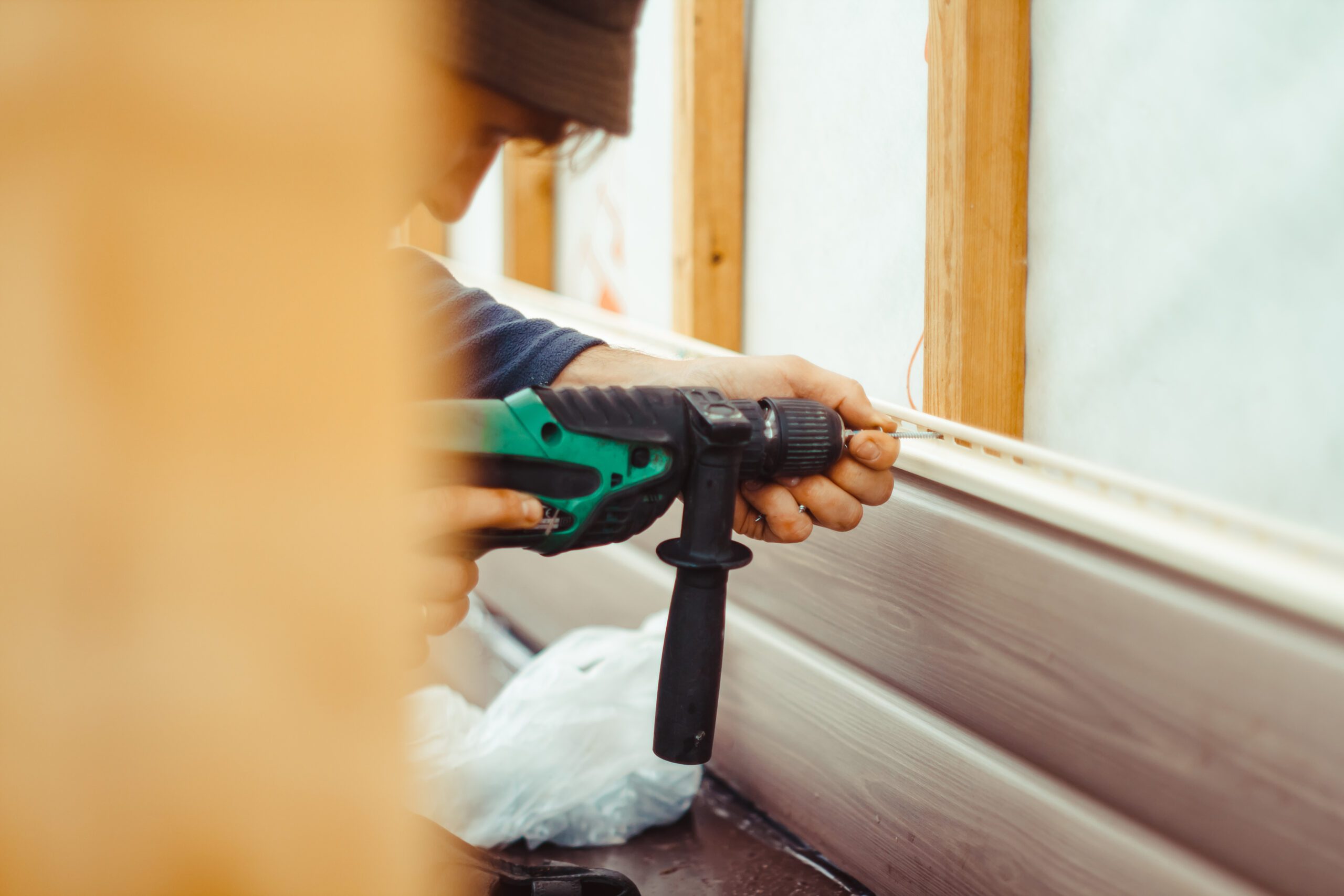
A worker installs beige siding on the facade of the house
Material-Specific Repair Considerations
Not all siding materials are equally repairable. The product on your home affects what’s realistic.
Can Vinyl Siding Be Effectively Repaired?
Yes, vinyl is one of the more repairable siding materials. Panels can be unlocked from neighboring courses using a zip tool, swapped out, and re-locked. A skilled installer can do this without disturbing the rest of the wall.
The catch is color matching. Vinyl fades over time from UV exposure, and the rate varies by exposure direction and panel color. New panels of the same color won’t visually match panels that have been on your home for 10+ years, especially on south or west-facing walls. Many manufacturers also discontinue colors over time, meaning the exact match may not exist anymore. Leach Construction primarily installs CertainTeed vinyl siding, which carries 30-35 year manufacturer warranties and offers better long-term color availability than budget brands.
For repairs that will be highly visible, this is sometimes solved by sourcing replacement panels from a less-visible area of your home (like behind a deck or in a low-traffic corner) and using new panels to fill that hidden spot instead.
What About Fiber Cement Repairs?
Fiber cement siding like James Hardie can be repaired, but it’s more involved than vinyl. The boards are attached differently, often using face-nailing or blind-nailing patterns that require carefully working around adjacent boards.
Color matching is the harder problem. James Hardie’s ColorPlus Technology is factory-applied and cured between coats. Field-painted replacements may not match the ColorPlus finish exactly, and even ColorPlus replacement boards may show slight differences as the original finish weathers. For homes with prefinished fiber cement, partial replacement of an entire elevation often produces a better visual result than spot repairs scattered across a wall.
There’s also a warranty consideration: improper repair work may void portions of the manufacturer warranty. Anyone working on James Hardie products should follow Hardie’s installation specifications to keep your coverage intact.
Diamond Kote and Prefinished Steel Siding
Prefinished products like Diamond Kote have factory-applied finishes that are extremely difficult to replicate in the field. Field-painted touch-ups rarely match the factory finish in either color or sheen, and any field paint won’t carry the same fade and weathering performance as the original finish.
For these materials, partial wall replacement or full elevation replacement usually produces a cleaner result than individual panel repairs. The factory finish stays consistent across the section you replace, even if it doesn’t perfectly match older panels elsewhere on the home.
The Patch Matching Problem Across All Materials
The underlying truth across every siding material is that older siding has been weathered, faded, and aged by sun and seasons. New panels are factory-fresh. The two will not look identical, and on a sunny day, an attentive observer will usually be able to spot a repair.
This isn’t a reason to avoid repair – a slightly visible patch is far better than ongoing water damage. But it’s worth setting realistic expectations: a repair will perform like new siding, but it won’t be invisible.
What About Partial Replacement?
Most repair-vs-replace conversations skip over the middle option entirely, but it’s often the right answer. Partial replacement means redoing one or more full elevations rather than spot-repairing damaged panels or replacing the entire home.
When Does Replacing One or Two Walls Make Sense?
Partial replacement works well when damage is concentrated on specific elevations – typically the walls with the most weather exposure. North-facing walls in shaded yards often deteriorate faster from moisture retention. South and west-facing walls weather faster from sun exposure. Walls without overhangs take more direct rain impact.
If you have one or two clearly worse elevations and the rest of your siding is in good shape, replacing just those walls gives you fresh, properly installed protection where you actually need it. The cost is typically 40-60% of full replacement. Learn more about our complete siding services, including the materials and installation methods we use.
What About a Phased Approach?
Partial replacement also works as a budget strategy. You can tackle the most damaged walls now and plan to replace the remaining walls in a year or two as budget allows. This spreads the cost while addressing the most urgent problems immediately. Leach Construction offers 0% financing for 25 months on qualifying projects, which is another tool for managing the cost of a complete replacement without phasing.
The trade-off with phasing is that your siding won’t all match. New panels next to weathered panels will be visually distinct, and the difference will be more pronounced on a phased project than on a single-shot full replacement.
The Visual Consistency Challenge
This is the main downside of partial replacement: the visual transition between new and old siding. Some homeowners solve this by choosing a complementary contrasting material or color for the new section, turning the transition into an intentional design feature rather than an obvious patch. Others accept the temporary visual difference, knowing the rest of the home will be replaced within a year or two.
If you’re planning to sell within 5 years, the visual inconsistency of phased replacement may hurt resale value compared to either a complete replacement or accepting the look of older siding throughout.
How Insurance Affects Your Repair vs. Replace Decision
If your siding damage came from a covered event – storm, hail, fallen tree, fire – insurance may significantly change the math on repair vs. replace.
When Does Insurance Cover Full Replacement vs. Repair?
Most homeowner policies cover repair of storm-damaged siding to its pre-loss condition. The question becomes what “pre-loss condition” actually means when matching siding isn’t available.
If the adjuster can find replacement panels that match your existing siding, they’ll typically cover repair of just the damaged sections. If they can’t find a match – either because the color is discontinued or because the existing siding has faded beyond what new panels could replicate – many policies require replacing enough siding to restore a uniform appearance. In some cases, that means full replacement.
The “Matching” Question with Insurance Adjusters
Some states have explicit matching statutes requiring insurers to replace adjacent undamaged materials when needed to achieve a reasonably uniform appearance. Michigan’s insurance regulations don’t include a strict matching statute, but most policies still address matching through their replacement cost provisions.
The practical issue: insurance adjusters may push for the cheapest repair that brings damaged areas back to working order. Homeowners or their contractors may need to make the case for broader replacement when matching genuinely isn’t possible. Documentation matters here – photos of failed match attempts, manufacturer letters confirming discontinued colors, written estimates from suppliers showing the closest available match.
What Documentation Strengthens Your Case for Replacement?
If you’re working with insurance after storm damage and believe replacement is warranted, the following documentation helps:
- ✓ Photos of all damage from multiple angles, taken as soon as possible after the event
- ✓ Wide shots showing damage across multiple elevations
- ✓ Close-ups showing impact patterns or specific failures
- ✓ Manufacturer documentation confirming your siding’s age, color, and product line
- ✓ Written confirmation from suppliers if the product or color has been discontinued
- ✓ Contractor estimates for both repair and replacement scenarios
- ✓ Evidence of pre-existing wear (if any) so the adjuster can’t claim damage was already there
Having an experienced contractor present during the adjuster’s inspection often produces better outcomes than handling the claim alone. They can point out damage the adjuster might miss and make the technical case for replacement when it’s genuinely the right call. Leach Construction regularly meets with insurance adjusters on behalf of our customers to help document storm damage properly.
When in Doubt, Get an Honest Assessment
The right answer to “repair or replace” isn’t always obvious from the curb. A professional assessment can confirm whether you’re looking at localized damage with sound structure underneath, or symptoms of a broader system failure.
What Should You Look for in a Siding Evaluation?
A useful siding evaluation includes:
- ✓ Walking inspection of all four elevations, not just the damaged area
- ✓ Removal of at least one damaged section to verify sheathing and moisture barrier condition
- ✓ Documentation of the damage pattern and likely cause
- ✓ Honest assessment of repair feasibility, including color matching prospects
- ✓ Cost estimates for both repair and replacement scenarios where both are viable
- ✓ Clear explanation of what factors are pushing the recommendation in either direction
Red Flags from Siding Contractors
Be cautious of contractors who:
- Recommend full replacement without inspecting the actual condition behind the visible damage
- Refuse to consider repair as an option regardless of the damage scope
- Push hard for a same-day signed contract
- Provide verbal estimates only, with no written documentation
- Can’t explain why repair won’t work in your specific situation
- Appeared at your door immediately after a storm without being called
For more on vetting contractors before any siding project, see our guide on what every homeowner should know about home improvement contractors.
Frequently Asked Questions About Siding Repair vs. Replacement
How long does a siding repair typically last?
A quality siding repair on sound underlying structure can last as long as the surrounding siding does – often 15-20+ years for vinyl or fiber cement. The key variables are installation quality, condition of the sheathing and moisture barrier underneath, and whether the original problem was properly addressed. In Michigan’s freeze-thaw climate, installation quality matters even more than the materials used.
Can you repair just a few panels of siding?
Yes, individual panel replacement is one of the most common siding repairs. For vinyl, this is typically straightforward – panels unlock from each other and can be swapped out. For fiber cement and prefinished products like Diamond Kote, individual panel repairs are possible but color matching becomes the limiting factor.
Does homeowners insurance cover siding repair?
Most homeowner policies cover sudden damage to siding from covered events like windstorms, hail, fallen trees, or fire. Gradual wear, age-related deterioration, and maintenance issues are typically not covered. Coverage may pay for repair of damaged sections, or in cases where matching siding can’t be sourced, broader replacement.
How much does siding repair cost compared to replacement?
Individual panel repairs typically run $200-$500 per occurrence. Single-wall repairs often fall in the $2,000-$4,000 range. Full siding replacement on a Metro Detroit home generally ranges from $15,000-$25,000 for vinyl up to $35,000-$70,000 for premium fiber cement, depending on home size, material, and trim complexity. When cumulative repair costs approach 25-30% of replacement cost, replacement usually becomes the better long-term value.
Is it worth repairing 20-year-old siding?
Usually not, especially for vinyl. Twenty-year-old vinyl is approaching the end of its expected lifespan, color matching is typically impossible due to fading and manufacturer discontinuations, and the next problem is likely close behind. Fiber cement has a longer useful life and may still be worth repairing at 20 years if it’s in otherwise good condition.
Can siding damage from one storm lead to full replacement?
Yes, in two common scenarios. First, when storm damage is widespread enough that repair cost approaches replacement cost. Second, when matching panels aren’t available and insurance policies require restoring a uniform appearance. Both situations come up regularly after major Michigan storm events.
Why Choose Leach Construction for Your Siding Project
When you’re trying to decide whether your home needs siding repair or full replacement, the contractor walking your property matters as much as the answer they give you. Leach Construction has served Metro Detroit homeowners since 1965 with three generations of construction experience in the same family. Here’s what sets us apart:
- ✓ Licensed & Insured – Michigan Residential Builder License #262000527
- ✓ Family Owned & Local – Headquartered in St. Clair Shores since 1965, rebranded as Leach Construction in 2017 (originally Rich & Sons Home Improvement)
- ✓ Free Inspections & Estimates – We’ll walk your property and give you a straight answer about your real options
- ✓ Quality Materials – We primarily install CertainTeed vinyl siding, James Hardie fiber cement, and Diamond Kote, all with strong manufacturer warranties
- ✓ 0% Financing for 25 Months – Available on qualifying projects to make the right solution affordable
- ✓ Honest Recommendations – If repair is the right call, we’ll tell you that. We’ve built our reputation on three generations of straight answers.
- ✓ Serving the greater Metro Detroit area – Wayne, Oakland, Macomb, St. Clair, and Washtenaw counties
Owners Dennis Leach and Michael Perri personally oversee every project, from the initial walkthrough to final cleanup. You’re not getting passed off to a call center or a salesperson – you’re working with the people whose name is on the truck.
Ready to Get an Honest Answer About Your Siding?
Don’t spend another season wondering whether that damaged panel is a quick fix or a sign of something bigger. The longer you wait, the more weather works on whatever’s happening behind your siding.
Call Leach Construction today at 586-822-1981 or visit LeachConstruction-MI.com to schedule your free siding assessment. We’ll walk your property, inspect what’s actually happening behind the visible damage, and give you a straight answer about your real options – whether that’s a targeted repair, partial replacement, or a complete siding project.
You can also submit an inquiry through our website and we’ll be in touch within 24 hours.